
Do the events of January 2026 in Syria set the conditions for an Islamic State Resurgence?
Context
There was much fanfare in March 2025 when the Syrian Transitional Government (STG) and the Kurdish Syrian Democratic Forces (SDF) reached an agreement to integrate the SDF-governed North-Eastern Syria (NES) into Syria.
However, this early positive step soon began to grind into political deadlock and military skirmishes. After seizing control by force of two historically Kurdish neighbourhoods of Aleppo in January 2026, the STG subsequently launched a rapid strike on two fronts into NES, which rapidly unbalanced and overwhelmed the Kurdish-led forces. The subsequent withdrawal of the SDF from the Arab-majority areas they had governed for over a decade redrew the lines of political control, over a deeply complex social and geopolitical landscape.
It also marked a sea change in an area within which the embers of the Islamic State’s (IS) low-level insurgency had smouldered since the final defeat of its ‘caliphate’ in Baghouz in 2019. Over the course of a few days, the strongly anti-IS SDF – previously a key partner with forces of the Global Coalition Against Daesh (or Coalition Forces / CF) – had lost its control over territory within which much of the remaining IS elements existed.
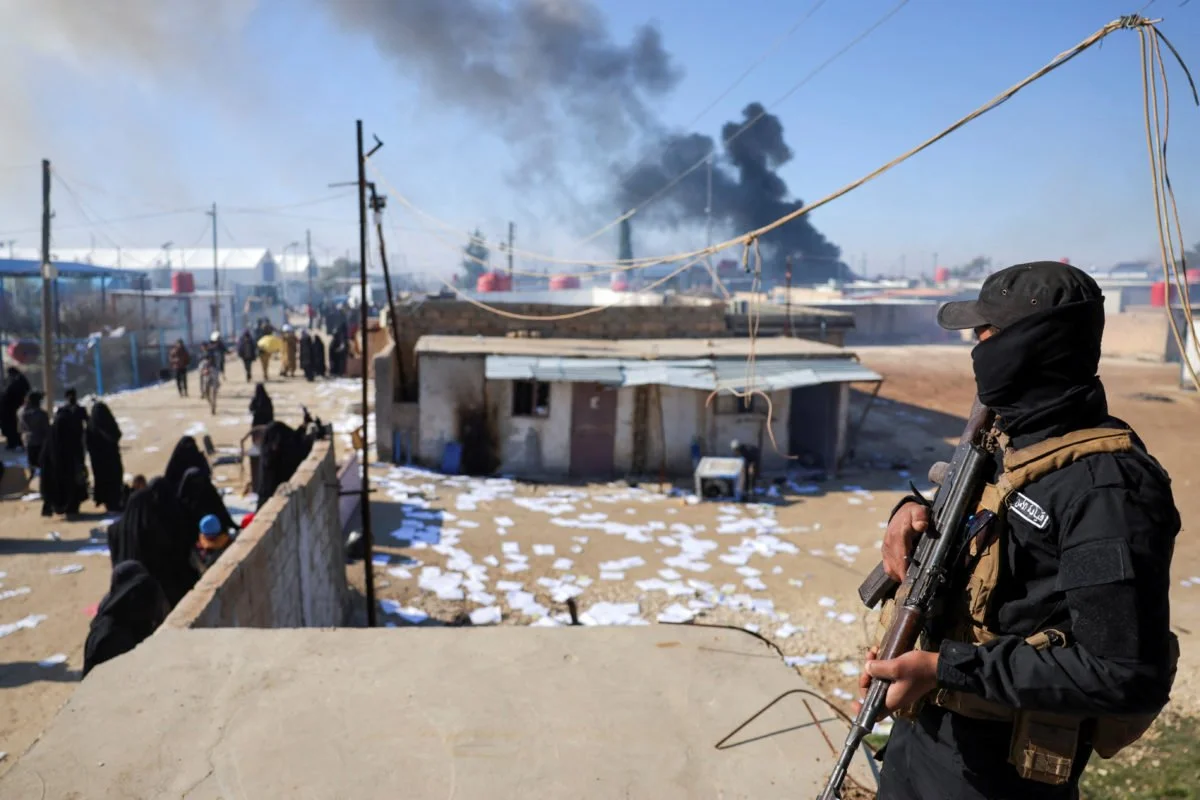
Simultaneously, STG forces gained control of a number of detention facilities holding IS terrorist suspects, as well as Al-Hol, the sprawling displaced persons camp in NES in which tens of thousands of IS-linked family members have been held.
What is the state of IS currently?
Since the 2019 collapse of the Islamic State’s so-called caliphate, the nature of its activities have changed from a conventional fight to a low-level insurgency, operating from challenging terrain and within fragile security environments of Syria’s eastern Badia area, which stretches across Homs, Raqqa and Deir Ezzour provinces. Though it is unclear how many core fighters it can call upon after years of CF and SDF pressure, it still remains an organisational structure that unifies military command, internal security, religious and ideological direction, propaganda, and logistics – in a well-dispersed and compartmentalised manner. Its recent tactics have centred around assassination, IED's camera cross-border or desert trades, and taxation and extortion. These efforts appear to be designed to indicate its continued presence and relevance, despite its loss of territory.
While in the weeks following the STG takeover of NES, minimal direct action from IS has taken place, its propaganda machine has gone into overdrive. Its mouthpiece publication, Al-Naba, reacted rapidly to the changing events and dedicated a significant piece to the ‘liberation’ of Al-Hol, while now deriding the STG President Ahmed Al Shara’a as a more faithful lackey to the Americans than even the SDF chief, Mazloum Abdi, had been.
Regardless of its propaganda effort, however, external actors have continued to warn, and take action, against the threat from IS that remains. The UN warned this week that the threat from feel the organisation has grown steadily since mid-2025, and that it has been adapting effectively to the changes in its operating context. US CENTCOM has itself carried out 5 airstrikes on IS positions in late January and early February, citing both the continued IS threat and also as retaliation for the killing of two US service personnel in Palmyra in December 2025.
Factors conducive to an IS resurgence
A number of elements combine to suggest that the events of January 2026 will be of great benefit to IS. Without a doubt the group thrives in ungoverned spaces, particularly in those with fragile security arrangements, such as the Iraqi-Syrian border regions and the Badia – areas in which the tribal and familial structures, poverty, unemployment and perception of being oppressed (particularly under the Kurdish authorities) as well as deeply held conservatism, have proved to be fertile grounds within which IS has been able to take root. Given how its core force are stretched trying to control the entirety of Syria, it remains to be seen whether the STG’s forces will be able to dominate the ground in NES effectively enough to disrupt any IS consolidation.
Similarly, the dissolving of the US Kurdish counter-IS mission – with US envoy Thomas Barrack recently stating that the SDF’s role as primary partner in the effort had “largely expired” – without a clear replacement arrangement or strategy, will contribute in the short-term to less pressure on IS. The CF, operating across NES, had historically deployed special forces troops alongside SDF ground forces, backed up by air power, to fix IS and prevent it from regrouping.
The difficulties of securing and managing IS suspect detainee facilities during this period is another contributory factor. The challenges of managing this array of facilities and inmates, on such a significant scale and spread across a wide geographical area, will be a significant learning curve for the STG. Numerous terror suspects have already escaped from detention facilities in Raqqa and Deir Ezzour during the chaos of the STG advance and SDF withdrawal, as have many families from Al-Hol. These individuals potentially provide fresh lifeblood to the IS, either as combatants or, at very least, supporters and sympathisers now in circulation outside of captivity.
While the SDF was almost entirely united in its anti-IS stance, it appears that the STG is not. Indeed, the STG incorporates a diverse set of factions and degrees of religiosity, including many of which remain much closer in alignment to IS – and given that IS has now firmly set itself in opposition to the STG and its ideological position, and is seeking to demonstrate how the STG and Shara’a are moving away from their Islamist, conservative roots, this is a key point of vulnerability for the Damascus government.
The results of this spectrum have most notably seen in incidents such as the attacker of the US servicemen in Palmyra, a member of the government security forces affiliated with IS; in the highly supportive sentiments expressed by government-affiliated fighters for the inhabitants upon reaching Al-Hol; in the action of a fighter from the Syrian Arab Army who was killed trying to infiltrate into the Al-Hol camp and extract families linked to IS; and in the sanctioning of a Syrian Army divisional commander for having directly employed former IS fighters. Given the hardline stances of many members of the Shara’a government, this is a key consideration that Shara’a has to take into account as he seeks also to work with the international community – potentially limiting his ability to pursue a substantial anti-IS operations in a way that the SDF had no qualms in doing.
Factors working against a resurgence
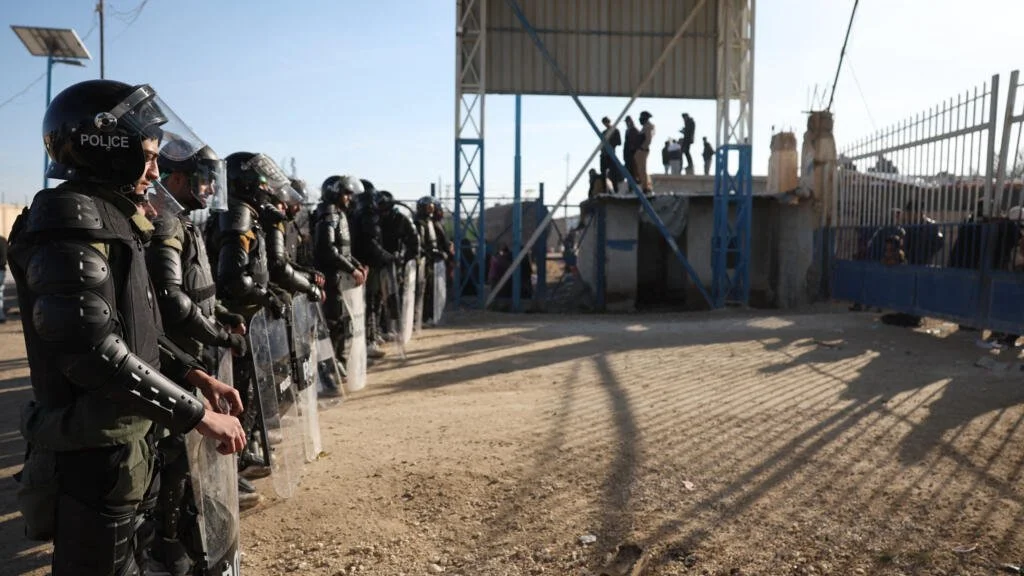
One key element is the removal of potential future fighters for the organisation. The CF as already commenced operation to transfer as many as 7,000 suspected IS members, previously held in a set of detention facilities cross NES and administered by the SDF, to prisons in Iraq. While this action only moves this pool of potential members to a neighbouring country, it secures them for the foreseeable future against being accessed more readily than within the currently uncertain setting of NES.
The US and CF counter-IS effort will likely continue now in cooperation with the STG. There appears to be still a strong imperative within the US government to do so: in its most recent Department of Defense budget for countering the IS threat, it stated as part of its justification that if IS is not effectively contained, then its fighters could re-emerge as a potent force, with implications for the region and globally. Some joint STG-CF activities have taken place to date, potentially providing a further bulwark against the reconstitution of IS in the region as this arrangement firms and possibly supersedes the previous SDF-CF coalition.
At the grassroots in NES, a number of local tribal groupings remain firmly opposed to IS, remembering the brutality of the so-called caliphate during its heyday and the oppression that it wrought. This opposition previously involved cooperation with the SDF and CF, the formation of local defense units, and the provision of intelligence on IS activities in the area. While the arrangement may change somewhat, the core of resistance to an IS comeback likely remains the same.
Summary
At this juncture, it appears highly likely that the Islamic State will derive tangible benefit from the upheaval of recent weeks. The rapid collapse of established security arrangements in north-eastern Syria, the transfer of territorial control, and the disruption of long-standing counter-IS pressure mechanisms together create precisely the type of environment in which the organisation has historically proven adept at operating.
This does not suggest an imminent return to territorial control or a revival of the so-called caliphate. Rather, it points to an increased opportunity for IS to reconstitute elements of its insurgent network, exploit gaps in governance and security, and replenish its ranks through escapees, sympathisers, and marginalised communities. The combination of stretched STG capacity, various hardline elements with the government highly sympathetic to IS, unresolved detainee management challenges, and the absence – at least in the short term – of a clearly articulated successor framework to the SDF-led counter-IS mission, all serve to lower the barriers to such consolidation.
At the same time, significant constraints on it remain. Continued Coalition activity, the partial retention of SDF forces in Kurdish-majority areas, and enduring local resistance to IS ideology and methods will complicate any sustained resurgence. The trajectory of the threat will therefore depend less on IS intent – which has remained consistent – and more on the ability of the STG and its partners to rapidly establish coherent security arrangements, maintain pressure on IS networks, and prevent the emergence of permissive spaces in which the group can once again embed itself.