
Q&A: The battle for Hadhramaut and the future of southern Yemen’s independence movement
Yemen has, yet again, made headlines in recent weeks, but this time the spotlight is not on the Houthis but on the territories held by the internationally-recognised government. Can you summarise events in eastern Yemen in the past month and explain how they fit into the broader conflict context?
In early December, forces belonging to the UAE-backed separatist group, the Southern Transitional Council (STC), overtook the governorates of Hadhramaut and Al-Mahra. Although the STC has maintained a presence along Yemen’s southern coast, it has long sought to expand into these regions in the east, which are controlled by the Republic of Yemen Government (ROYG) and Saudi-backed forces. The STC has argued that bringing these regions under its control would help combat terrorism and smuggling, and counter the Houthis—the group that controls much of northwestern Yemen and is the shared enemy of the STC and the ROYG. However, Hadhramaut and Al-Mahra are important strategic territories for a number of players, namely the ROYG itself (who has lost some control of southern Yemen to the STC in recent years) but also Saudi Arabia and Oman, who share borders with these governorates. Hadhramaut and Al-Mahra are also relatively stable regions of Yemen that have, up until this point, largely been spared frontline fighting and airstrikes.
Many local Hadhrami and Mahri tribes and political elites are opposed to the STC and the UAE’s increased presence in eastern Yemen. It is also worth mentioning that Hadhramaut contains natural resources such as oil and gas reserves, and important seaports, airports, and military bases. These economic, political, and military factors have all played a role in the struggle over Hadhramaut.

View of Shibam in Wadi Hadhramaut, October 2023, Hannah Porter
The STC and its Emirati backers apparently saw an opening to seize Wadi Hadhramaut in early December. The STC forces pushed through and took the territory in a surprise move that appeared to reveal a lack of preparedness on the part of the ROYG forces. There was also suspicion that the STC was seeking to expand its territory in anticipation of a nationwide political process, to position itself for maximum influence during negotiations.
However, within less than a month, Saudi airstrikes targeted the STC and the port of Al-Mukalla, where a shipment of weapons was reportedly being delivered to the southern forces. Fighting broke out on the ground and the STC was forced to withdraw from its newly acquired positions. President Rashad Al-Alimi, head of Yemen’s Presidential Leadership Council, declared a state of emergency and announced that he was cancelling a joint defense pact with the UAE, ordering Emirati forces to leave Yemen within 24 hours.
On 7 January, a delegation of 50 STC leaders traveled from Aden to Riyadh to participate in “talks” to discuss the issue of southern Yemen independence. STC President Aidrous Al-Zubaydi had the foresight to decline the invitation and instead boarded a boat to Somaliland before flying to Abu Dhabi. He has since been charged with treason. Upon landing in Riyadh, the STC delegation had all communications cut and they have not been heard from since.
Does this mean the end of the STC? If so, what is the future of the southern Yemen independence movement?
The STC will not remain with the same degree of significance and influence that it has enjoyed in recent years, and the dissolution of the group seems inevitable. Last Friday, the STC Secretary-General Abdulrahman Al-Subaihi said in a televised statement that the dissolution of the group was taken to preserve peace and security in the south and in neighbouring countries. However, other leading members of the STC have voiced their insistence that they will remain, and large protests were seen in the past week in support of the group. The southern cause is unlikely to evaporate; the desire for secession or independence has existed in some form or another since the country’s unification in 1990.
Although the UAE has claimed a full withdrawal from Yemen, there is reason to be skeptical that Emirati influence in the country has disappeared overnight. The UAE has spent a decade investing in its presence across southern Yemen, and has funded, trained and equipped a variety of armed groups, not just the STC. As we have seen since the Saudi-led coalition’s intervention in 2015, alliances and partnerships in Yemen’s conflict shift frequently and sometimes unpredictably. The continuation, or reintroduction, of UAE influence in Yemen is a possibility.
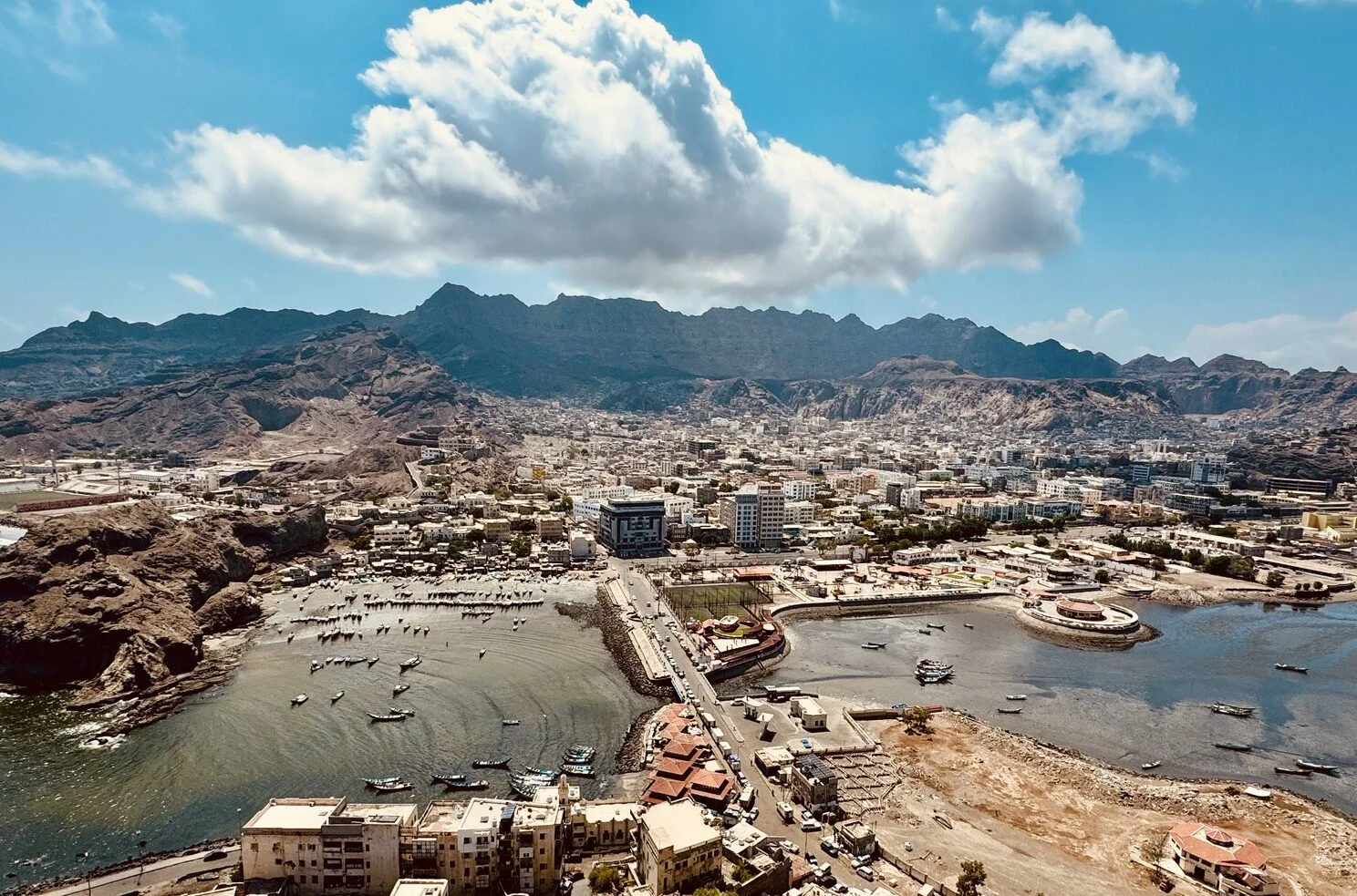
View of Aden from Seera Castle, October 2024, Hannah Porter
If the STC was responsible for manning checkpoints, providing security, or countering terrorism in the south, how will those efforts be impacted by this sudden power shift? How will recent events impact smuggling routes in areas previously held by the STC?
In the immediate aftermath of the STC withdrawal, it appears that local forces and the Saudi-backed, pro-ROYG National Shield Forces took control of territory previously held by the STC. However, it is not clear how easily or smoothly this transition will take place, and it is unlikely that pro-ROYG forces were prepared for such a rapid collapse of the STC.
Eastern and southern Yemen contains important smuggling routes, where weapons, goods, and drugs are transported overland and via ports on the southern coast. The numerous checkpoints throughout this region are intended to stem the flow of illicit goods, but just as often function to extort average Yemenis as informal taxes (jabayat) are levied by security forces looking to compensate for their poor salaries. If ROYG forces want to improve security and counter smuggling, they will need to earn the trust of local communities. In some ways, this dramatic power shift could be an opportunity for the ROYG to bolster its legitimacy, but there are plenty of obstacles in its path.
How are the Houthis interpreting these developments? Do they view fighting between the UAE and Saudi Arabia as advantageous to them? Have they issued any statements about the events of the past month?
Initially, the Houthis likely viewed this development as advantageous to them. They see such events as proving their overall hypothesis that foreign, Western-backed intervention in Yemen (e.g., through the UAE or Saudi Arabia) is destructive and motivated by a desire to seize resources like oil and gas, including in Hadhramaut. The Houthis have been relatively silent about events in Hadhramaut, but their affiliated outlets highlight the Saudi takeover and the conflict between the two Gulf powers.
Fighting between pro-Saudi and pro-Emirati forces is also favourable to the Houthis since it divides the powers that are supposed to be unified against them. Events like this are also a distraction from the Houthis. For example, there has been little discussion recently of an operation to push the Houthis out of Al-Hodeida—a move that was promoted by pro-government voices a year ago.

A billboard in Aden featuring UAE President Sheikh Mohamed Bin Zayed, October 2024, Hannah Porter
It is also notable that the Saudis justified their airstrikes against the STC as an effort to protect Saudi border security, yet much of their border with Yemen remains under Houthi control. As always, the political reality is complex and nuanced, but this contrast in border policy implies tacit approval of Houthi presence, but a complete opposition to the presence of the STC.
At the same time, the Houthis must be observing that the Saudis are willing to use force to protect their interests. There was initially a concern that this apparent weakness on the part of the ROYG would spur the Houthis to make a push to take the oil-rich governorate of Marib. Now, the Houthis may see that the Saudis would likely respond with airstrikes, just as they have done with the STC. Additionally, PLC head Al-Alimi has announced the formation of a Supreme Military Committee, which has been tasked with preparing military forces for the next phase of the conflict and readying them if the Houthis reject peace.